Because Over-Engineering is Underrated
Integrated Vibration Dampers
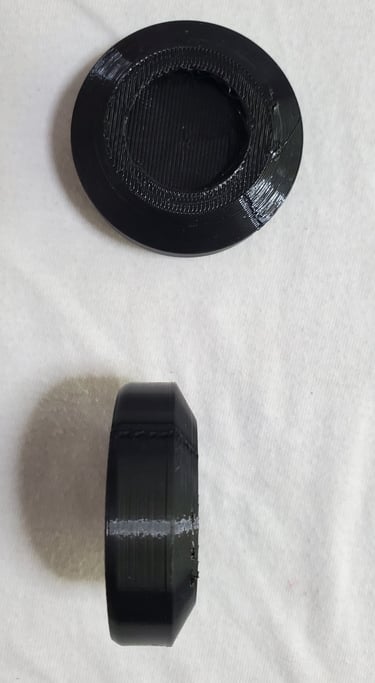
In refurbishing an early 2000s washing machine, we discovered that the rubber foot pads that covered the washer's metal leveling feet hand deteriorated and needed to be replaced. Spinning Jenny created custom designed replacement pads that both replaced the washer's original foot covers and provided the benefits of anti-vibration pads normally sold as aftermarket accessories. . Boy, was that a mistake.
PROBLEM STATEMENT
Because of EPA regulations around water use and electricity consumption, modern washing machines operate cleanly and efficiently while performing the task of not getting clothes clean. Washers made in the late 1990s and early 2000s use too much electricity and water, are often noisy, but get get clothes wonderfully and completely clean. Refurbishing them makes a lot of sense, but often parts, like the rubber foot pads that cover the washer's leveling feet and prevent the metal feet from gouging or scratching the floor, deteriorate. In this case, the original pads were completely dry rotted and required replacement.
Additionally. we carried out extensive research using online resources like Reddit (and I don't know about you, but I don't want to live in a world where random reddit commenters can't be trusted to be both knowledgeable and honest about things they comment on.) That research indicated that this particular brand and model of washer tended to vibrate. There was a broad consensus that the solution was to place anti-vibration pads under the leveling feet.
AoA: ANALYSIS OF ALTERNATIVES
OEM replacement parts are available for this model, but replacing all four would have cost over $50 and would not have provided the anti-vibration effect we wanted without also purchasing another $30 worth of pads. $80 was getting dangerously close to what we had paid for the washer, so we abandoned this approach.
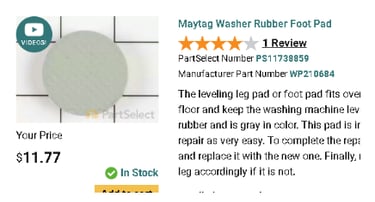
Another approach would have been to print replacement parts that closely resembled the OEM parts. This would have saved us from the $50 in cost for OEM equipment, but would not have provided the anti-vibration capability we wanted.
A third approach would have been to cut a piece of carpet and place it under the washer. In addition to the aesthetics, though, there were concerns about potential mildew and smells from having carpet under a washing machine. And it would have been harder to slide the machine on carpet than on four foot pads.
SOLUTION DEVELOPMENT
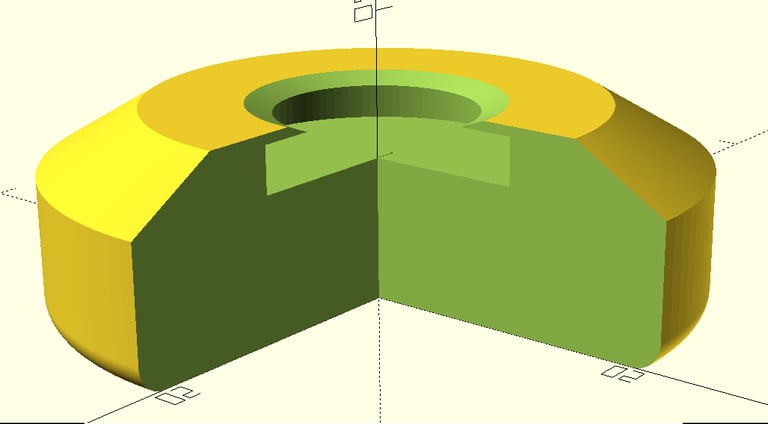
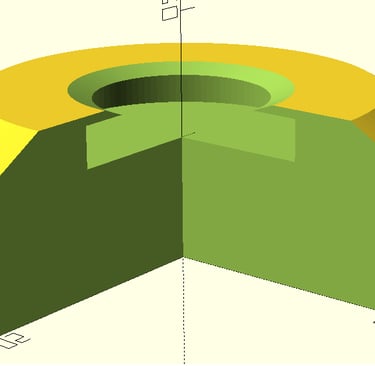
Spinning Jenny developed a custom combination leveling foot pad and anti-vibration pad for the washing machine. It combined a flared design to go from a relatively small chamber for the metal foot to a large bed which, it was expected, would absorb noise and vibration. The chamber was beveled with a flexible lip through which the metal washing machine foot could be inserted. Below the chamber, the pad expanded significantly to provide a cushion for the washing machine.
The feet were place snugly on the washing machine and it was lowered and moved into position. The first load revealed some minor difficulties with the design (see below.)
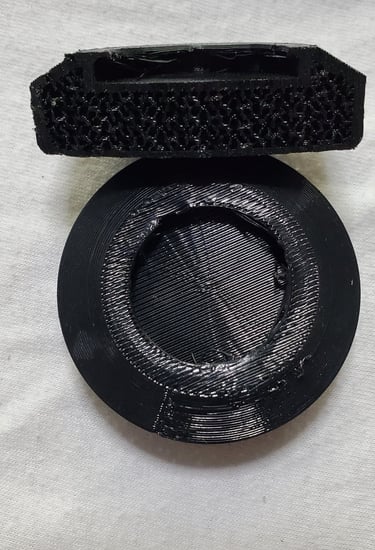
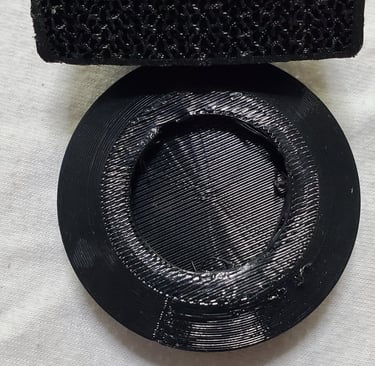
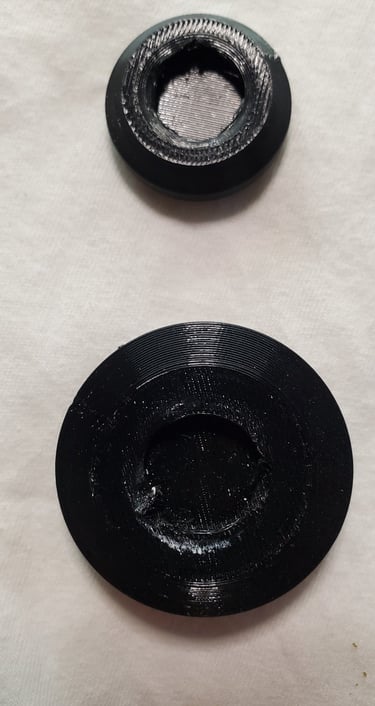
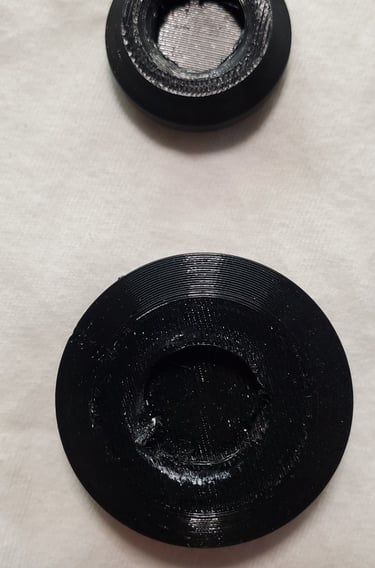
We redesigned the feet to be much smaller and more rigid, reducing diameter by two thirds and height by nearly one half, and made the pads more rigid. We switched from TPU-90A to a harder TPU-95A for the pad section (while continuing to use the softer 90A for the chamber and lip, to allow the foot to slip in.) Also for the pad section, we went from 40% infill using a gyroid pattern to a 95% density using a concentric pattern - essentially a solid foot. Again, for ease of installation, we retained the 40% infill and gyroid pattern for the chamber walls and lip. Note the difference between the new foot (top) and the failed bottom foot designs.
To achieve maximum vibration damping and to make it possible to fit the replacement foot as tightly as possible over the metal foot, the part was printed from TPU-90A. In fact, the chamber was actually .3mm smaller in diameter than the metal foot, allowing the pad to bite and hold the foot tightly.
A 40% infill was used in a gyroid pattern to give maximum shock absorption. 6 top shell layers were used to prevent tearing of the top lip, with 5 bottom shells and 4 wall loops for part integrity under load. Note the infill pattern in the cross-section to the left.
RESULTS
Despite the theory, the vibration damping approach made things much worse in practice, to the extent that the washing machine would walk across the floor during the spin cycle - so much so that at one point, it pulled the drain hose out of the wall. We would routinely find the washer at a 45 degree angle, prevented from turning further only by becoming wedged between the wall and the dryer.
It appears that, far from dampening the washing machine vibrations, our design was amplifying them. Our theory is that by coupling the anti-vibration pad to the foot, instead of sitting the machine's feet in the anti-vibration pads, we gave the washing machine something to bounce on instead of something to bounce in, which had the opposite effect of dempening.
It's also likely that we actually created feet that resonated with the spin of the washing machine, leading to spectacular vibration and bouncing during the spin cycles. The famous Tacoma Narrows Bridge collapse (left) is an example of the phenomenon.

It's a hell of a thing, resonance.
The redesigned pads almost completely eliminated the machine vibration, even during spin cycles with heavy loads. Maybe the smaller pads that came with the machine were the right idea after all. Who could have guessed? The beveled chamber lead-in and thin top lip did work well and were retained in the final design - the pads were easy to install but held firmly when the machine was pushed across the floor. Whether we eliminated a resonant coupling, or whether the smaller, more rigid pad stopped being like a bouncy castle spring for the washer and just became a hard foot, is an open question.
It was an interesting experiment that failed. Our only regret is not getting a video of the washing machine in action before replacing the feet. If anyone would like some disco moon shoes for their washing machine, get in touch with Jenny. It's not practical, and will eventually destroy the machine, but it really is entertaining to watch.